









How can technical and business teams be brought together around a shared web performance project? As part of an educational initiative to align the objectives of marketing, SEO, editorial and IT, Uni-Médias called on Fasterize. The web performance audit carried out, and the report delivered as part of this, formed the starting point for a comprehensive project to improve page load times for this press publisher. We spoke to Mustapha Omar, CTO of Uni-Médias (the press subsidiary of the Crédit Agricole Group, publisher of parents.fr, santemagazine.fr, dossierfamilial.com), who talks about the benefits of this audit and the role Fasterize played in fostering a web performance culture across all teams.
Fasterize: Why did you decide to carry out a web performance audit?
Mustapha Omar: In 2017, we created a headless
platform to bring all our publications together. This platform is based on Drupal with a Symfony
front-end. As for the content, it is indexed in Elasticsearch. We were starting from scratch when it came to web performance best practices; everything had to be built from the ground up. From experience, I know that despite our best efforts, a website’s performance can deteriorate as it evolves. We therefore needed an external expert’s view to assess where our performance stood, how to maintain it, and how we compared with the
online
press market. As web performance requires constant attention and techniques evolve rapidly, this audit was also an opportunity to take stock of our areas for improvement.
Fasterize: What tools have you put in place to monitor your website? Have you set any targets or a performance budget?
M. O.: We have indeed set a
performance budget
and implemented tools to analyse the speed of our websites. We use Dareboost with alerts set up for various web performance indicators, particularly
page size and server response time. The technical team receives these alerts as well as a weekly report to enable them to continuously maintain and improve loading times. For example, we have set a maximum page size of 2MB, including adverts. To set this threshold, we based our decision on the performance of the top five sites in the JDN’s mobile media web performance ranking, which have an average page size of less than 3MB. We also ensure that the Time To First Byte
remains below 200ms, as recommended by Google. Unfortunately, we no longer meet this target since the widespread switch to HTTPS: 300 ms on 4G/ADSL and 700 ms on 3G (HTTPS involves additional network round trips due to key exchange. Even with a perfectly optimised back-end,
TLS 1.3
negotiation adds latency – editor’s note).
Fasterize: How do your teams organise themselves to maintain performance?
M. O.:
All teams are aware of the importance of loading times: IT, Marketing, Digital, Editorial, SEO
…
The SEO teams know that Front-End Optimisation (FEO) and search engine optimisation are linked. Indeed, the faster search engine crawlers can scan pages, the easier they are to index. Google states that loading speed is one of the criteria taken into account when crawling pages. Consequently, speed is important not only for our users but also for boosting our visibility in search results. This aspect has become even more important following Google’s latest announcements regarding
Mobile-First
Indexing. In our case, mobile accounts for 70 per cent of our traffic, so it is very much in our interest to optimise our websites for this device. Digital marketing teams are also affected by web performance. We use Google Tag Manager and Google Ad Manager to serve adverts, which are third-party content essential to our business. Like third-party content, images
are also indispensable, but they add weight to pages and can slow them down. The IT team is looking to set up an alert system to notify Marketing if any content needs optimising to meet the performance targets we have set. Our aim is to enable everyone to take the necessary steps, sometimes in collaboration with third-party publishers if required.
Fasterize: What techniques have you implemented to meet these web performance targets?
M. O.: To ensure sites are fast right from their redesign, we’ve applied essential web performance best practices: minification of JavaScript, HTML and CSS, and concatenation of JavaScript and CSS.
We have also opted for a
CDN
to manage and optimise images. They are no longer served directly from the main domain, but from servers that
automatically resize
them according to each user’s context. We prefer this process to be handled by a dedicated third-party service to reduce the computational load on our servers (nearly 60 per cent of our users access the site via Chrome,
which favours the WebP format). Furthermore, opting for this SaaS-based solution allows us to benefit from continuous improvements and this partner’s expertise in media management. And beyond the tools themselves
, we are also enhancing our teams’ skills through web performance monitoring. Our front
-end development teams have thus developed the habit of testing any changes with Lighthouse
before deployment. Finally, to ensure that the speed of our
desktop and mobile sites remains a priority for all teams, we use regular meetings to share web performance KPIs. We even share technical knowledge with the business teams to get everyone involved!
Fasterize: What results have you seen following the optimisation of your websites?
M. O.: User experience (UX), particularly for our mobile sites, was a priority in our redesign project. We have some great brands (Santemagazine.fr, Parents.fr, etc.) with high-quality content produced by expert journalists. The attention we’ve paid to optimising our platform and reducing load times has helped to deliver a better user experience and improve the visibility of our publications.
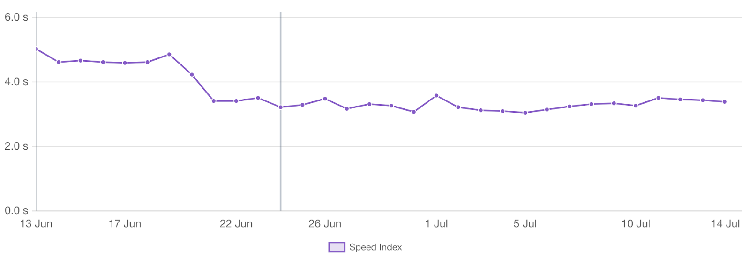
Analysis of the latest redesign and migration carried out for DossierFamilial.com (end of June 2019).
The same trends were observed for Parents.fr and Santemagazine.fr, as well as Parents.fr
In concrete terms, the Santé Magazine website has seen its traffic increase more than sixfold in two years: it has risen from 2 million per month to 13 million thanks to the combination of all our efforts, particularly in relation to loading speed.
Fasterize: To conclude, what are the key takeaways from this web performance audit?
M. O.: Every market has its own specific challenges. In the media sector, third-party providers are essential to the business, but they can also impact performance and the measurement of loading times. It was precisely to address these specific challenges that Fasterize guided us towards Custom Metrics. Thanks to these custom web performance metrics, we’ve been able to take our monitoring further and make it more granular, particularly when it comes to third-party scripts. Fasterize took care to take our specific needs into account. The recommendations, which were tailored to the realities of our business, helped to embed web performance within both the IT and business teams. It was important for us to have external advice and to be able to draw on the expertise of a team specialising in web performance. This helped us to unite all stakeholders behind a shared project. This audit enabled us to establish the understanding that web performance is not a
one-off
project, but something that must be driven continuously by all teams.
Would you like to find out more about our web performance audits and be contacted by our experts?