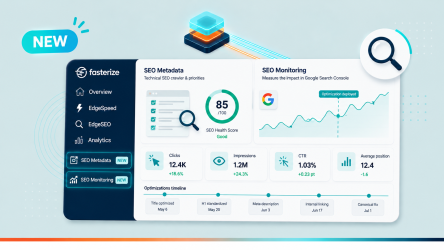











This month, we have further improved our platform to ensure better readability of our clients’ data and improved performance of their websites, all while maintaining security.
Among these improvements are:
1/ Better security:
We have migrated our website and API to HTTPS and updated our password policy:
- Passwords must now meet a minimum character length requirement.
- Passwords will expire after a certain period.
- Failed login attempts will be limited. Once this limit is reached, the account will be frozen.
2/ More efficient Gzip
Late last year, Steve Souders (a web performance pioneer) conducted a study to better understand which resources to compress.
While Gzip is an essential optimization for good performance, sometimes the result after compression is larger than the original.
Of course, the majority of content served by Fasterize was already compressed using Gzip, but following this analysis and to avoid this issue, we updated our Gzip settings. What’s changed:
Since our update, we now apply Gzip:
- to standard extensions: js, css, html, etc., as well as to: json ico eot otf ttf
- to these content types: application/x-javascript text/css application/javascript text/javascript text/plain text/xml application/json application/vnd.ms-fontobject application/x-font-opentype application/x-font-truetype application/x-font-ttf application/xml font/eot font/opentype font/otf image/svg+xml image/vnd.microsoft.icon
3/ More ergonomic and precise monitoring
To better measure the results of our solution, we improved the ergonomics and readability of the data on our monitoring page.
We specifically eliminated outliers* that caused “noise” and prevented clear data interpretation.
This allows us to quickly see technical performance differences in an A/B test scenario.
*Here we mean: extreme values that do not reflect reality and may skew the average.
4/ More relevant tracking on Google Analytics
You can evaluate page load times directly in Google Analytics. However, by default, this measurement is done on 1% of visits.
This low percentage is not an issue when evaluating a high-traffic website.
However, for lower-traffic websites, it is recommended to adjust this parameter. To avoid misinterpretation, we modified the Google Analytics tag we implement for our clients so that the measurement is done on 100% of visits.
These improvements allow our clients to enhance the performance of their websites and enjoy a better user experience.