








TL;DR
- AI Overviews now appear at the top of Google results for a growing share of queries. When an AI summary is displayed, click-through rates on classic results drop sharply. The impact on organic traffic is real, but it can be managed.
- No need to reinvent your strategy: SEO fundamentals remain the foundation of visibility in generative answers.
- Four workstreams to focus on: produce content that answers your audience’s questions directly, make information readable and accessible for AI bots (structured data, key content outside JavaScript, audited WAF and robots.txt), strengthen your authority and brand signals, and set up structured monitoring of your AI presence across three layers: presence, readiness, business impact.
AI Overviews have changed the shape of the search results page. An AI-generated summary now sits above the organic links for a growing share of queries, and the data is unambiguous: when that summary appears, clicks on classic results fall sharply. The good news is that the levers for staying visible in this new environment are well understood, and they rest largely on fundamentals you already master. Here is how to approach it.
What is an AI Overview and how does it work?
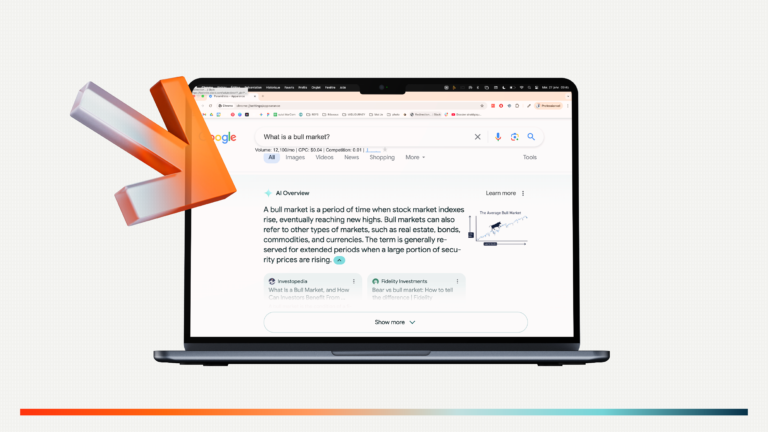
An AI Overview is a Google feature that automatically generates a summarised answer directly on the results page, before the traditional organic links. Powered by the Gemini model and grounded in the Knowledge Graph, this overview aggregates several sources, rephrases the information and presents it as a conversational synthesis.
From SGE to AI Overviews: a strategic evolution
In May 2023, Google unveiled the Search Generative Experience (SGE), a prototype that took over a very large share of the screen. A year later, AI Overviews marked a clear evolution: a more compact format, triggered on a targeted share of queries, but integrated far more systematically into search.
The user gets an immediate, structured, often sufficient answer… without needing to click. Welcome to the era of augmented zero-click.
Source vs citation: the distinction that changes everything
In the AI Overviews ecosystem, not all pages play the same role. The difference between being a “source” and being a “citation” is the line between shadow and light:
- The source (the data input): it feeds and refines the generated answer behind the scenes. The AI uses it to understand the topic, but it remains invisible to the user. Consequence: it improves the AI, but generates almost no traffic to the originating site.
- The citation (the clickable proof): it is explicitly surfaced in the overview through a chip, a link or an accompanying card. Consequence: it is what captures attention and receives the clicks, turning the AI into a genuine traffic driver.
The game is no longer just about ranking well in the blue links. It is now about being selected, extracted and identified as a visible reference, sometimes even from outside the traditional top 10.
What the data reveals about the impact
Studies converge: pages exposed to an AI Overview can see their CTR fall sharply, sometimes in the region of -30% to -60% depending on context (according to data from Seer Interactive). Even when a page is cited, click volumes remain below what classic organic links historically delivered.
But the main risk is not purely volumetric. In markets where the feature is active, the clearest patterns are an erosion in the yield of informational content, strong volatility in visible sources and a progressive dilution of mid-funnel value. Being cited does not create a gain: above all, it limits the relative loss.
Another figure should shape your thinking: the vast majority of AI Overviews are triggered on informational queries: definitions, guides, comparisons, FAQs, tutorials. Transactional queries remain less exposed, but the trend is clearly upwards.
The pattern is consistent across markets: a marked CTR drop for heavily informational sites, a more nuanced impact for specialist sites, and an AI Overviews presence concentrated in the research phase rather than the conversion phase for ecommerce.
Optimising for Google AI Overviews: your four-part action plan
1. Content strategy: switch to answer-first mode
Generative AIs do not read content linearly. They break a query down into sub-questions, also known as “fan-out queries”, then reconstruct their answer from fragments extracted across several pages. In this context, clarity beats exhaustiveness, structure beats volume, and natural language beats generic phrasing.
The editorial principle becomes simple: answer before you explain. Every piece of content should open with a short, direct answer that makes sense without context, forming the fragment the AI can extract as is. The rest of the content then serves to deepen, contextualise and convince.
The most effective formats are those that produce standalone, easily recombinable blocks: explicit FAQs, clear lists, comparison tables, visuals with usable captions. On informational content, regular updating is essential to remain eligible for AI answers and to maintain the credibility of the fragments being used.
This logic extends beyond your own site. Brands frequently mentioned in third-party content (articles, comparisons, videos) appear more readily as references in generative answers. AI visibility therefore also depends on a brand’s ability to be recognised and cited across the wider ecosystem, not solely on its on-site optimisations.
2. Technical SEO: make information readable and accessible for AI bots
Generative AIs do not simply read text. They try to understand what a page is, its role and its level of reliability. A well-structured site reduces ambiguity and makes it easier to extract relevant fragments.
Structured data plays a key role here. It clarifies the nature of content (FAQ, guide, product, article) and strengthens the overall readability of the site. On high-stakes topics, the sources cited in AI Overviews come predominantly from sites identified as expert and well structured.
Beyond markup, though, it is editorial organisation that makes the difference. Coherent topical clusters strengthen credibility on a subject and increase the chances of being drawn into an AI answer.
There is one condition many teams overlook: none of this matters if AI bots cannot access the content itself. First point of vigilance: JavaScript. Most AI crawlers render JS poorly or not at all. Key content injected client-side (product descriptions, FAQs, reviews, prices) risks being simply invisible to them. Important content elements must be present in the server-delivered HTML, without depending on JavaScript rendering.
Second point, often neglected: check that you are not blocking AI bots yourself. Anti-bot rules in WAFs and CDNs, designed to filter scraping, regularly intercept legitimate AI crawlers. The same goes for robots.txt: legacy or overly broad directives can exclude your site from generative answers without anyone noticing. A cross-audit of WAF + robots.txt + server logs is the prerequisite before any editorial optimisation.
In the same spirit, some approaches are exploring the conversion of HTML pages into lighter formats such as Markdown. Markdown strips out rendering noise and is simpler to parse. Still experimental, admittedly, but consistent with the shift towards a web that is more readable for AI agents.
3. Performance & UX: Core Web Vitals as a prerequisite
AI Overviews are not triggered on just any page. Before content relevance even comes into play, AI systems must be able to access a site quickly, extract cleanly and interpret its information reliably.
Field data shows a clear correlation between technical performance and the probability of being used as a source. Fast, stable, lightweight pages are more easily exploitable by AI systems, whereas overweight HTML, late rendering or visual instability make it harder to extract the right fragments.
Performance does not “win” you anything in itself, but it conditions eligibility. It acts as a silent filter, without which editorial and semantic optimisations lose much of their impact.
4. Monitor: measure your AI presence continuously
International studies show that AI Overviews can drive significant traffic losses. But the effects often settle in diffusely: a progressive CTR decline, volatility in cited sources, a loss of clarity on SEO’s real contribution to the business. Hence the need for a structured measurement setup, not simply another dashboard.
The framework proposed by Aleyda Solis is currently the most operational reference on the subject. It articulates three complementary measurement layers:
- Presence: does your brand appear in the AI answers that matter to your business? Here you measure coverage of strategic queries, the rate of citation with a link, and the accuracy of how the brand is represented in generated answers.
- Readiness: are you structurally ready to be cited? This diagnostic layer explains why visibility is weak or unstable: technical accessibility of content, ease of information extraction, consistency of brand signals, corroboration by third-party sources.
- Business impact: does this visibility create measurable value? Referral traffic from AI engines, indirect signals such as a rise in brand searches or direct traffic to cited pages, modelled estimates. Each indicator is reported with its confidence level, without trying to merge everything into a single score.
One concrete and underused lever to feed all three layers: your server logs. They are the only place where you can actually see which AI bots visit your site, which pages they crawl and how often. A page never crawled by AI bots will never be cited. Log monitoring thus becomes a leading indicator of your eligibility for generative answers, before any impact shows up in Search Console.
Finally, observe your own SERPs on your strategic queries, and keep observing them: which content disappears from the visible zone, which remains exposed despite the Overview, which brands manage to emerge without depending on the click. These observations are worth more than any speculation.

Valentine’s view, SEO expert at Fasterize:
Google has confirmed it: there is no need to reinvent your strategy to appear in AI Overviews. Good SEO practice remains the foundation, so whatever you do, don’t skip the fundamentals.
Use case: when seasonality redefines visibility
The November-December cycle perfectly illustrates the logic of AI Overviews.
A key lesson, notably observed by BrightEdge: Google adjusts their presence significantly across the year, with a particularly visible impact in ecommerce.
In November, the research and discovery phase, AI Overviews trigger massively on comparative queries: “best X for Y”, “Z buying guide”. This is when the battle plays out on informational content. FAQs, comparisons and structured guides become critical entry points.
In December, the logic reverses. As intent becomes transactional, AI Overviews recede in favour of conversion-oriented results. Priority then shifts to product pages, availability, pricing and the activation of paid levers.
In other words, AI Overviews are not just an SEO topic. They belong to a broader dynamic: a search engine that adapts in real time to users’ dominant intent.
AI Overviews: fast adaptation as a competitive advantage
AI Overviews are rewriting the rules. Users no longer systematically click to get informed: information is consumed directly on the SERP, before any navigation.
In this context, ranking well is no longer enough. Being used as a source is not enough either. What matters now is the ability to be identified as a visible reference, exploitable and credible for AI systems.
This shift goes beyond SEO. It rests as much on content structure as on brand recognition across the digital ecosystem. The players who come out ahead will be those able to combine editorial clarity, external presence and the capacity to adapt.
Fasterize: built for the AI Overviews era
Every workstream described in this article shares one requirement: a cross-cutting view that most organisations simply do not have. Content, technical SEO, performance and measurement live in different teams and different tools. The result: nobody sees the full chain, from detecting a blocker to measuring the impact of fixing it.
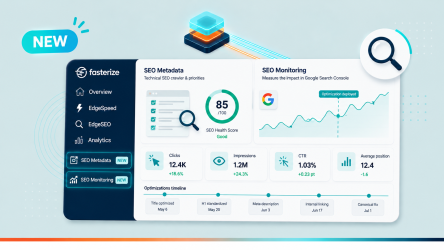
That is the loop Fasterize reconnects: detect what is holding back your visibility, prioritise by business impact, deploy optimisations directly on your pages without mobilising development teams, and measure the results.
Concretely, on the levers that drive AI Overviews eligibility:
- Deploy structured data at scale: add FAQ, Product or Article markup across thousands of pages in days, where a dev ticket would take months.
- Reveal what JavaScript hides: expose key content currently injected client-side in the server-delivered HTML, so it is readable by every AI crawler.
- Restructure content in answer-first format: insert direct-answer blocks, FAQs or simplified HTML-to-Markdown formats, and measure their effect.
- Secure the performance prerequisite: fast, stable, lightweight pages that AI systems can exploit more easily, the silent filter described in part 3.
The priority is to launch your AI Search optimisations now: the impact is already visible wherever AI Overviews are active, as well as in LLM-driven environments.
This is no longer a forward-looking topic. It is already under way. And in a search landscape that has become dynamic, the advantage goes to those able to iterate faster than the market.