









There are probably hundreds, maybe thousands, of pages on your website that Google has never discovered.
Not because they are poorly optimized. Not because your content is bad. But because a link somewhere in your navigation, breadcrumb trail, or footer still points to an old URL.
This problem has a name: 301 inlinks, and more broadly, internal links pointing to 3xx, 4xx, or 5xx URLs. It is common, widespread, and silently costs you a little crawl budget, a little visibility, and a little organic traffic every day.
And it keeps growing quietly with every redesign, migration, and URL change. New redirected links accumulate. For months, sometimes years, without anyone really noticing. We know the issue exists. We just do not fix it. Detection happens in one tool, correction in another, and proof is nowhere to be found.
This is exactly what Fasterize has just changed.
Broken internal links: a problem everyone knows, but very few actually fix
On paper, an internal link pointing to a 301 URL may seem harmless. The redirect does its job, the user lands on the right page, and everyone moves on.
Except Googlebot, and now AI bots such as GPTBot, ClaudeBot, or Perplexity’s crawler, do not move on quite so easily.
Each redirect means two HTTP requests instead of one.
Imagine a mail carrier who has 500 letters to deliver in a day. Every time an address has been redirected, they have to make the journey twice: first to the old address to read the forwarding note, then to the new one. Their daily quota does not change. They simply deliver fewer letters.
The same thing happens with crawlers: average response time goes from 361 ms to 682 ms, almost twice as long, and crawl budget gets used up faster. And crawl budget is anything but abstract.
Botify estimates that around 50% of pages on large websites are never crawled by Google. Product pages, articles, landing pages left invisible. Not because they are badly optimized, but simply because Googlebot ran out of budget before reaching them.
With the rise of AI bots now crawling the web to answer user queries, this pressure on crawl resources will only increase.
And this issue is not limited to large websites. According to Ahrefs, it affects 95% of domains. Small, medium, or large, every website accumulates redirected internal links over time through redesigns, migrations, and URL changes. It is almost mechanical. So why does it not get fixed?
Everyone knows about it. Audits flag it. Crawling tools have detected it for years. And yet, 301 inlinks continue to pile up.
The answer lies in what happens next.
The real friction comes after detection
Detecting the issue is the easy part. Screaming Frog, OnCrawl, or any serious crawling tool can flag it in a few minutes. What comes next is where things get stuck.
Let me introduce Coralie, SEO manager for an e-commerce website with 320,000 product pages. She has just completed her crawl. She knows exactly which links point to 301s, on how many pages, and with what volume of hits. She even has the destination URLs in front of her. On paper, the fix looks simple.
In reality, Coralie is about to spend the next few weeks, maybe months, chasing something that may never actually move. The workflow looks like this: export the data from the crawler, cross-check it with server logs to prioritize, manually build the correction rule, then submit a ticket to the development team.
And this is where things get complicated.
The dev team has its own priorities: conversion funnels, performance, security. An SEO ticket asking them to correct several thousand redirected internal links rarely lands at the top of the backlog.
So the ticket waits. Sometimes for weeks. Sometimes for months.
And even when the fix finally gets deployed, the work is not over. A new crawl has to be launched to verify the correction, the data has to be cross-checked with Search Console to see whether Google reacted, and a report has to be built to show the impact to management. The most frustrating part is the disproportion.
Updating an href attribute in the HTML is a trivial intervention for a developer: one minute of work, at most. The real difficulty is not the correction itself, but everything around it: detection in one tool, correction in another, and proof nowhere to be found.
In the end, the lack of visible ROI makes serious prioritization almost impossible.
Fasterize sees what crawlers are looking for
To detect her 301 inlinks, Coralie used an external crawling tool. She launched a spider across her website, waited for it to crawl hundreds of thousands of pages, and retrieved the report.
Several hours of processing to get a snapshot at a specific moment in time, one that will already be partially outdated the following week. Fasterize works differently.
The solution sits directly in the website’s traffic flow and sees in real time what is happening through logs: which URLs return 301s, which pages those links come from, and how often Googlebot encounters them each week.
Not a snapshot taken from time to time. A continuous, always up-to-date flow. This is the shift Fasterize is making today.
Not building yet another crawler, there are already dozens of those.
But using what the solution already sees continuously to turn a technical signal into an actionable business opportunity.
Identify performance levers. Suggest the fix. Deploy it. Measure the impact.
Without an external tool. Without exports. Without waiting for the next weekly crawl.
What Coralie had been looking for in Screaming Frog for hours, Fasterize sees continuously and can now show her directly in the platform.
From Assessment to ROI, without switching tabs
Coralie opens Fasterize.
In just a few seconds, she sees what her crawler had flagged. Patterns are detected and prioritized, with the business volume attached to each one: how many 301 hits are wasted every week, and what the destination URL is.
One click to approve the corrections.
One click to deploy.
No dev ticket, no waiting, no internal negotiation.
What used to take three weeks now takes ten minutes.
But the real breakthrough is what comes next.
In the following days, Fasterize shows her two curves: the decline in 301 inlinks on one side, and soon, a visualization of the bots crawling her pages.
For the first time, Coralie can show her management team what an SEO correction has actually changed.
This is no longer evangelization.
It is data.
This is only the beginning
301 inlinks are the first use case.
A good example, because everyone knows this problem and yet very few teams actually fix it. But if you look back at what Coralie just did, you will see that the story is not really about inlinks.
It is about a different way of working.
A tool that continuously detects what your crawlers spend hours trying to find, based on a snapshot that is already outdated. A tool that fixes issues without tickets, without roadmap delays, without negotiating with a dev team that has other priorities. A tool that measures what each action actually changed, with curves to prove it, and finally gives you an answer when management asks: “what did this actually deliver?”
For years, closing this loop required three tools, two teams, and a lot of patience.
Now, it takes one screen.
And the momentum has started.
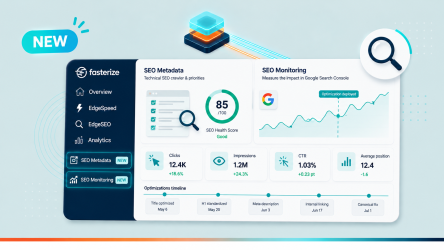
Two new applications are now available on Fasterize:
SEO Monitoring, to prove the impact of every optimization deployed: your clicks, impressions, and positions, directly from your Search Console data, with a clear before-and-after view.
SEO Metadata, which scans your entire catalogue, calculates a health score, and tells you what to fix first, prioritized by real impact.
Two applications. Two new opportunities to test, demonstrate, and make decisions based on data rather than intuition.
We will introduce them in more detail very soon.
This is the direction we are moving in: with every new application, more of your technical debt becomes a business lever.
Inlinks 301 is the first building block. More is coming.