








Google has announced two new features for publishers: a dedicated performance report for AI-powered Search experiences and the ability to exclude a website from those same experiences. The rollout is currently limited to a small group of websites in the United Kingdom, and no global launch date has been announced.
For now, it’s a UK-only pilot
The first important detail is that these features are currently available to a subset of site owners in the UK, with plans to expand access over time. Google is taking a gradual rollout approach to allow for extensive testing before a wider release. At this stage, no official timeline has been shared. So if you don’t see anything new in your Search Console account yet, that’s perfectly normal.
A first performance report dedicated to AI experiences
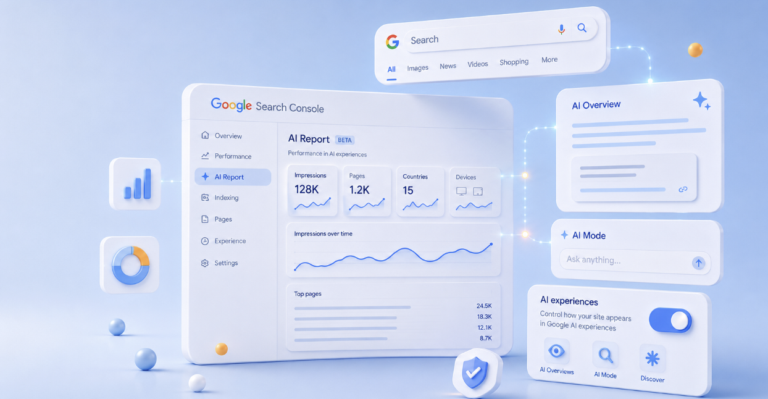
The new report provides data on how your website performs across Google’s generative AI experiences within Search.
Until now, website owners had no first-party data to measure their visibility in these surfaces. This is the first reporting tool specifically designed for AI-powered search experiences within Search Console.
The report currently covers AI Overviews and AI Mode, although Google has stated that the scope will evolve over time. Experimental features available through Search Labs are excluded.
What the report measures… and what it doesn’t
The report includes data on impressions, pages, countries, devices, and dates, with time granularity ranging from hourly to monthly.
This allows website owners to track visibility trends over time, identify which pages appear in AI-generated responses, and understand where impressions are coming from.
An impression represents the number of times a link to your website was displayed to a user within a generative AI feature in Google Search. There is no position data, no visibility rate, and no engagement metric – only presence volume.
The most obvious omission is clicks.
As reported by Barry Schwartz at Search Engine Roundtable, a Google spokesperson explained that the company is still working with publishers to determine which metrics would be most useful and that additional reporting capabilities will be introduced over time.
In other words, it is now possible to know how often your content appears in an AI-generated response, but it remains impossible to know how many users actually clicked on it.
The report therefore provides a first layer of visibility without yet making it possible to measure its true business impact.
A toggle to opt out of AI experiences
Beyond the reporting feature, Google is also introducing a toggle in Search Console that allows websites to prevent their content from appearing in AI Overviews, AI Mode, and AI Overviews in Discover.
On paper, the option is straightforward.
In practice, however, it raises a much more strategic question.
By enabling this setting, a website will stop appearing in these AI experiences and will therefore no longer generate impressions, traffic, or revenue from those surfaces.
Google has been quick to reassure publishers, stating that this decision will not be used as a ranking signal for traditional search results. In theory, opting out of AI experiences should not affect a website’s organic search performance.
Two important caveats deserve attention.
The first is that this mechanism only applies to Google’s own AI-powered search experiences. It has no impact on generative search engines such as ChatGPT, Perplexity, or Claude.
The second is more obvious: if a website is excluded from AI experiences, the new performance report is unlikely to appear in Search Console, simply because there would be no impressions to measure.
A new way to analyze SEO performance
Beyond the new metrics, this announcement represents a broader shift in how visibility on Google is measured.
Until recently, strong rankings in traditional search results were the primary indicator of SEO success. With the rise of generative experiences, that equation is becoming more complex.
A page that ranks exceptionally well in traditional search may never be referenced in AI Mode. Conversely, a page with limited organic visibility may become a preferred source for AI-generated responses.
Organic search is no longer just about rankings in the SERPs. Visibility now extends across new surfaces, each with its own selection mechanisms.
The fact that Search Console finally distinguishes between these different types of visibility may ultimately be the most significant aspect of this announcement.
A strategic question more than a technical one
The other key takeaway concerns the opt-out feature. The real question isn’t whether it’s possible to leave AI experiences.
The real question is whether it makes sense to do so.
Should publishers accept being featured in responses that may generate relatively few clicks but potentially strengthen brand visibility? Or should they focus on preserving traffic to their own websites?
For e-commerce businesses, publishers, media organizations, and marketplaces, there is unlikely to be a universal answer.
This decision will need to be evaluated against business objectives, acquisition strategies, and the additional data Google may introduce in the future.
A first step toward greater transparency
These new features remain limited, both in terms of geographic availability and available metrics.
Nevertheless, they represent an important milestone.
For the first time, Google is providing first-party data on website visibility within its generative search experiences. And while the available metrics remain incomplete, they open the door to a much more sophisticated understanding of SEO performance in the age of AI.
Google has already indicated that the report will continue to evolve. Its scope will expand, additional metrics will be introduced, and SEO teams will gradually gain a clearer picture of how their content performs within these new environments.
For now, all that’s left to do is wait and hope these new capabilities arrive in your Search Console account sooner rather than later.
We’ll keep you updated
Subscribe to our newsletter to stay informed about the latest developments in SEO, AI Overviews, and generative search.