








A few weeks ago, Aleyda Solis, founder of SEOFOMO, published the results of her annual study of e-commerce SEO professionals across 24 countries. A serious study, conducted among experienced practitioners, half of whom have more than ten years in the field. And across the responses, one tension emerges with troubling regularity.
Teams know what to do. They have the audits, the analyses, the recommendations. What they don’t have is the ability to deploy.
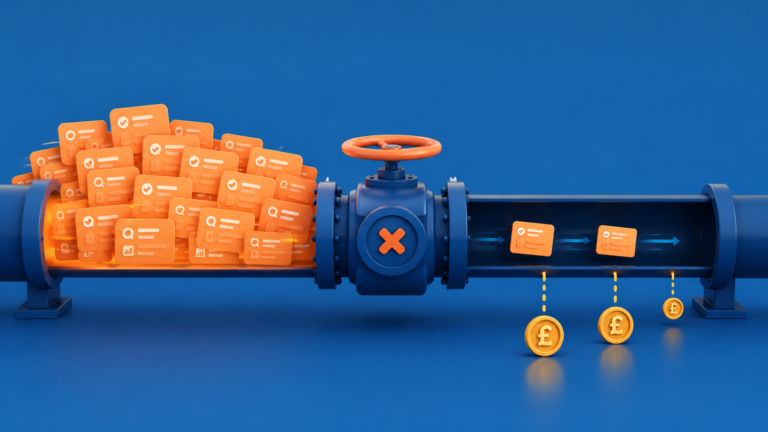
This isn’t a skills problem. It’s an organisational one. And for many marketing directors, it’s a silent loss that appears on no dashboard.
What the SEOFOMO Survey really reveals about E-commerce SEO
SEO Teams remain dependent on IT resources to move forward
When respondents were asked why their SEO projects fell short of their targets last year, the number one answer was neither lack of budget nor algorithm volatility. It was implementation.
Between 35 and 40% of responses point to the same frictions: development backlogs, insufficient IT capacity, delayed execution, complex architectures, internal workflows that slow everything down. Teams that know exactly what they should be doing, and watch the calendar slip.
“Slow implementation.” “Development backlogs.” “Lack of capacity from dev teams.” The verbatims are blunt. They describe a reality that many CMOs recognise without necessarily naming it: in many e-commerce organisations, SEO doesn’t move at the pace of search engines. It moves at the pace of IT cycles.
And that pace is structurally different.
SEO requires rapid iteration, testing, continuous adjustment. IT cycles follow different logic: planned sprints, project arbitration, technical debt management. An urgent SEO optimisation can sit in a backlog for six months without anyone being at fault. It’s simply the collision of two incompatible timelines.
Technical SEO remains the priority and the biggest point of friction
89% of respondents say that technical SEO is part of their core activities. It is cited as the absolute priority by 35 to 40% of the sample for this year. Crawlability, indexability, site architecture, Core Web Vitals, schema markup: the fundamentals remain fundamental.
What is striking is the paradox: technical SEO is simultaneously what teams consider most important and what they struggle most to advance. Because this is precisely where IT dependency is strongest.
Fixing a crawl issue, restructuring an internal linking architecture, deploying schema markup at scale… none of these actions can be accomplished without going through the development team. And when development is occupied with other priorities, these fixes remain pending. Sometimes for weeks. Sometimes for months.
One revealing detail in the survey: among the causes of failure, some respondents cite “poorly executed technical implementations.” This isn’t just a delay. It’s a recommendation that was finally deployed, but incorrectly. The double cost of waiting, then getting it wrong.
Search Engines are changing faster than organisations
89% of respondents are already integrating AI Search optimisation into their processes, or plan to do so very shortly. That figure would have been unthinkable two years ago. It says something important about the speed at which the landscape is transforming.
The survey identifies AI-driven SERP changes as the second most common cause of missed targets, accounting for between 25 and 30% of responses. AI Overviews, new search features, increased paid ad placements, the emergence of AI Mode. Teams well-positioned in terms of rankings watching their traffic fall because the search results layout has shifted beneath them.
This is an environment where the value of an SEO recommendation degrades over time. Not because the recommendation is flawed. But because the context in which it was meant to apply has evolved while it sat waiting in the backlog.
SearchGPT, commerce agents, the UCP protocol… 53% of respondents have not yet implemented Universal Commerce Protocol (UCP) or Agent Commerce Protocol (ACP) but plan to do so in the coming months. The window for positioning on these new forms of visibility is open now. For how long, no one can say.
The hidden cost of blocked SEO roadmaps
What a deployment delay actually costs
The cost of an SEO delay is rarely accounted for. It doesn’t generate a line in a budget. It doesn’t trigger an alert in a report. It accumulates silently, in the form of traffic that never arrives, rankings that fail to improve, pages that remain under-optimised while competitors push ahead.
Consider a concrete example. A team identifies in January a series of technical optimisations likely to improve crawlability across several thousand product pages. The recommendation is validated. It enters the backlog. Deployment happens in July.
Six months during which those pages were less well indexed, less well ranked, less frequently surfaced. For an e-commerce site where 30 to 40% of revenue comes from organic traffic, a range the SEOFOMO survey confirms as the most common, that delay carries a real economic cost. Impossible to quantify precisely after the fact, but real nonetheless.
The reasoning in terms of lost value is straightforward: if an optimisation is likely to generate X% additional traffic across a category of pages, each month of delay represents a fraction of that gain deferred or permanently lost. And in an environment where SERPs are evolving, a recommendation designed for a January context may be partially obsolete by July.
Some results observed at Fasterize clients are telling. One saw SEO revenue grow by roughly 30% in the six months following the removal of its deployment bottleneck, not by changing strategy, simply by being able to execute. Another measured a 10% improvement in conversion rate after deploying technical fixes that had sat in a backlog for several months.
Why some organisations continue to overspend on Paid Search
There is another cost, even less visible. When organic SEO isn’t moving fast enough, organisations maintain or increase their paid search spend to compensate. This isn’t irrational in the short term. But it is a costly crutch that masks the underlying problem.
The equation is straightforward: the slower the SEO deployment, the more the organisation depends on paid channels to maintain its traffic and revenue levels. This dependency has a direct cost (the paid search budget) and an indirect one, often overlooked: the mechanical increase in customer acquisition cost (CAC) across paid channels.
CMOs who look only at the “SEO investment” line regularly underestimate this reality. The true calculation includes what the organisation spends on paid search to compensate for the inefficiency of its organic deployment. That figure is often substantial.
The hidden cost of lost competitive agility
The SEOFOMO survey reveals that 45% of respondents conduct SEO testing. This signals an industry beginning to adopt a logic of continuous experimentation: test, measure, iterate, arbitrate. An approach that assumes the ability to deploy changes quickly, observe results, and adjust.
That logic is structurally incompatible with long deployment cycles. When a test takes three months to set up, you’re not really testing. You’re making a long-term bet. Tactical precision disappears.
What the highest-performing organisations have is precisely the ability to bypass this dependency. Not by pressuring IT teams, they have their own priorities, often legitimate ones, but by creating an SEO execution layer that operates independently of development cycles.
The best-performing organisations are shrinking their time-to-deployment
Time-to-deployment sits at the heart of modern SEO performance. Not the time between idea and recommendation. The time between recommendation and production.
This is where the bulk of SEO competitiveness is decided today. Organisations able to deploy an optimisation in days, rather than months, operate in an entirely different regime. They test more. They iterate more. They adapt faster to algorithm changes and SERP shifts. And they turn SEO recommendations into business advantage before the opportunity window closes.
This velocity has measurable impact. At Baccarat, the differential between an EdgeSEO deployment and a traditional development approach on a specific optimisation was assessed at a factor of 100 in terms of ROI. Not because traditional development is ineffective, but because execution speed changes the economic equation fundamentally.
What these organisations have understood is that this isn’t about bypassing IT teams, or duplicating resources. It’s about creating an autonomous SEO execution capability, able to deploy technical changes directly at the edge, without waiting for a sprint, without opening a ticket, without product arbitration.
That is precisely what Fasterize’s EdgeSEO was designed to do: allow SEO and marketing teams to deploy technical optimisations (tags, redirects, structured data, crawl fixes) directly into production, with no development dependency and no CMS modification. A model that transforms technical SEO from an organisational constraint into an operational business lever.
For a long time, SEO was an analytical discipline. Audits, recommendations, reports. Value was measured by the quality of the diagnosis.
It is becoming an execution discipline. The quality of the diagnosis is no longer sufficient if the organisation cannot turn it into production quickly. In an environment where Google, AI Search, and the SERPs are in constant flux, execution speed has become a competitive advantage in its own right.
The real cost of SEO today is no longer just the cost of audits or tools. It’s the cost of SEO that never makes it into production.