








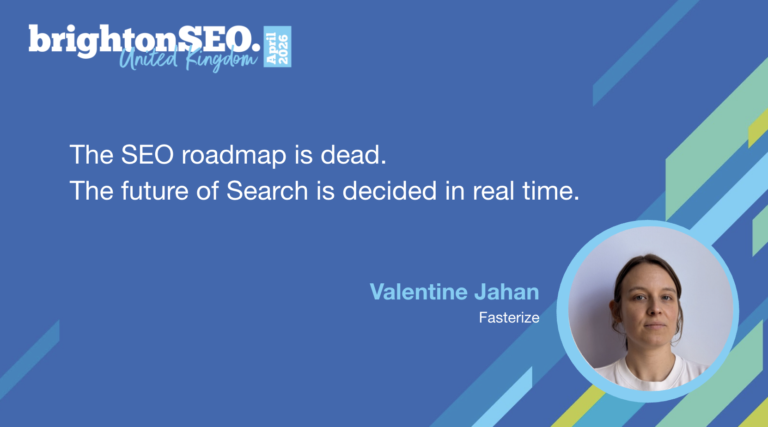
The SEO roadmap is dead. Search is decided in real time.
With the rise of LLMs, AI Overviews and the UCP protocol, SEO can no longer be managed solely through quarterly roadmaps. Results change fast. Formats are diversifying. Opportunities sometimes appear before teams even have time to add them to their backlog. That was the issue raised during this session. Between identifying an SEO opportunity and putting it into production, days, weeks or even months can still pass. In the meantime, your competitors move forward. Signals evolve, but tests are not launched. Recommendations pile up. And the roadmap, which is supposed to organise action, can become an operational debt. To respond to this new reality, Valentine Jahan presented the Real-Time-First approach. A model in which SEO teams no longer limit themselves to producing recommendations, but organise themselves to activate them quickly. This approach is based on two complementary pillars:- On one side, Agentic SEO, which makes it possible to collect, analyse, generate and prioritise actions based on SEO, business and AI data.
- On the other, EdgeSEO, which enables these actions to be deployed directly at CDN level, without waiting for a CMS modification, a ticket or intervention from the IT team.
Two concrete use cases presented during the talk
The talk did not stop at a theoretical vision. Valentine illustrated this approach with concrete workflows designed for large-scale e-commerce and retail websites.- The first example focused on faceted pages. On websites with large catalogues, faceted pages often represent a major SEO opportunity, but one that is complex to manage: indexation, canonicals, internal linking, content, search intent and crawl budget. The approach presented showed how to collect data, analyse relevant combinations, generate the required elements, then continuously deploy optimisations through EdgeSEO.
- The second example focused on enriching store pages at scale. Valentine presented a workflow designed to optimise more than 2,000 local pages for SEO and AI Search: content enrichment, LocalBusiness and FAQPage structured data, HTML content served to bots, SEO and GEO monitoring, revenue tracking and anomaly alerts. The results presented were compelling: more than 2,000 pages automatically enriched, a 10x increase in SEO clicks in four months, more than 5,000 keywords in the Top 10, as well as citations in ChatGPT, Gemini and Claude.
Moving from constrained SEO to actionable SEO
The goal of this talk was clear: to show how SEO teams can move away from a model blocked by processes.
And shift towards an SEO capable of testing, learning and performing at the real pace of search.
This vision strongly echoes the evolution of AI search engines. Visibility tomorrow will not depend only on the quality of the recommendations produced.
It will also depend on the ability to activate them quickly. To measure their impact. And to continuously adjust actions.
Thank you to everyone who came to meet us
Thank you to everyone who stopped by the Fasterize stand to discuss EdgeSEO, GEO and the new visibility challenges emerging in AI search engines.
These conversations confirmed one thing: SEO, digital and e-commerce teams are looking for concrete ways to reduce the time between analysis, decision and deployment.
That is precisely the role of EdgeSEO: to give organisations back their speed. To help them test faster. And to turn SEO recommendations into actions that are actually deployed in production.
The evolution of search does not make SEO less strategic. Quite the opposite.
But it does require organisations to rethink the way they execute.
What next?
The brands that gain an advantage will be those capable of quickly turning opportunities into concrete actions and measurable impact.
Would you like to know whether your website is ready for AI Search?
Request your AI Search audit.
Identify your visibility opportunities in AI search engines, your execution bottlenecks and the optimisations that can be activated quickly to strengthen your presence in ChatGPT, Gemini, Claude and the new search experiences.