








Since 5 May 2026, Lighthouse, Google’s benchmark tool for auditing web performance, has included a new check: the presence of an llms.txt file on your website. It now sits within a new category dedicated to agentic navigation. This is no longer just a community convention. It is a measurable metric.
Here’s what that means in practice.
What is llms.txt?
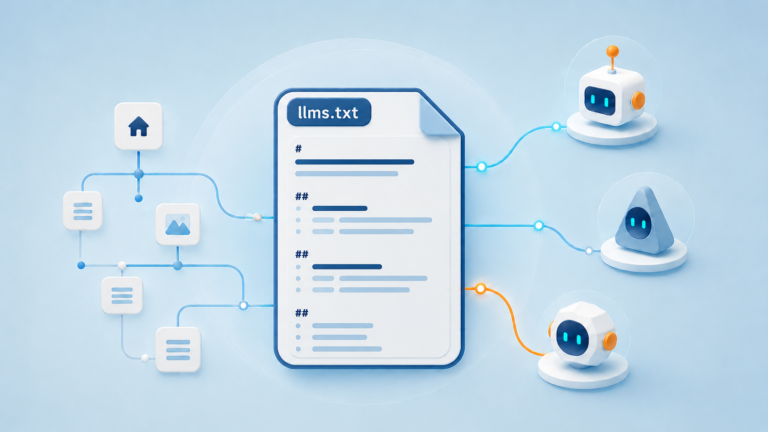
llms.txt is a text file placed at the root of your website, in the same location as your robots.txt. Its content is written in Markdown: a structured text format that can be read by both humans and machines, without HTML tags or code. Headings, lists, links. Nothing more.
Its role is to give AI tools a clear, organised reading of your website. Your key pages, your products, your guides, your offer. A map, rather than a territory to explore blindly.
What llms.txt does not do
Let’s be direct. In its official guide published on 15 May 2026, Google states this unambiguously: llms.txt receives no special treatment in its search systems. It will not boost your ranking in AI Overviews or AI Mode. It is not an SEO lever in the Google sense of the term.
This point deserves to be made clearly, rather than allowing poorly calibrated expectations to circulate.
So why does Lighthouse audit it?
Because Lighthouse is not measuring Google Search here. It is measuring agentic navigation: in other words, your website’s ability to be understood and used by AI agents that navigate the web autonomously, without going through a SERP.
These are two distinct realities. An AI agent arriving on your website without an llms.txt file has to explore page by page to understand your structure, identify your flagship products and grasp your positioning. With a well-built llms.txt file, it has a map. It understands faster, and more accurately.
This is precisely the agentic layer for which Lighthouse has created this new audit category.
Deploy it today, without touching the technical stack
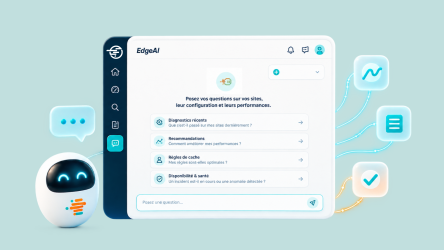
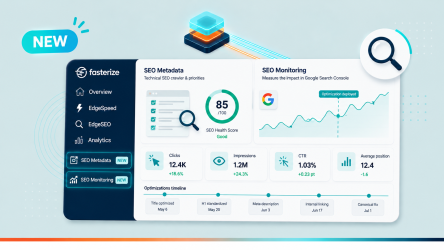
This is where EdgeSEO changes the game. Since June 2025, our clients have been able to deploy their llms.txt directly from the interface, without touching the CMS and without depending on a dev team. A few minutes are enough to get it live.
And to populate the file, there is no need to rewrite everything by hand. With html2Markdown, your existing pages are automatically converted into clean, agent-readable Markdown. You select the pages to include, and we take care of the rest.
Now it’s over to you: prepare your website for the agentic web!