








Strategic analysis · E-commerce & Search
For 25 years, the e-commerce model has relied on a simple equation: Google sends traffic, your site converts it. The Universal Commerce Protocol (UCP) does not break that equation, but it is starting to rewrite it. Here is why it matters to you now.
What UCP really is
UCP is an open-source protocol designed by Google to standardise exchanges between new AI interfaces (AI Mode, Gemini) and merchant systems. In practical terms, it enables a conversational agent to understand your offer, compare it with others, and potentially initiate a transaction without the user visiting your site.
The protocol relies on structured data exposed by the merchant: product description, price, availability, delivery times and conditions, payment methods, and returns policy. These are the data points the AI interface consumes first, not your design or UX.
Key takeaway. UCP does not replace your site. It creates a new entry point into your offer: an additional channel, not a substitute channel. For now.
Why this is happening now
This is not an isolated phenomenon. UCP is part of a broader trend: reducing friction between purchase intent and the act of buying. Each generation of technology has shortened this journey: Amazon’s one-click checkout, Apple Pay, integrated checkout on Instagram.
The AI interface goes one step further. It can anticipate a need, aggregate offers, compare prices and delivery times, and present a recommendation without the user having to open a single tab. It is the same logic, pushed to the extreme.
What AI can already do
- Understand an intent expressed in natural language (“I’m looking for a bike for my 8-year-old son, budget €300”)
- Aggregate and compare several offers
- Filter according to contextual criteria
- Suggest an option and explain why
What it will be able to do tomorrow with UCP
- Check availability in real time
- Retrieve an exact price, including promotions and stock levels
- Initiate an order without redirecting the user
- Compare delivery times between merchants
What this changes for you in practical terms
The question is not “will my site disappear?”. The question is: will your offer be readable by these new interfaces?
A poorly structured catalogue, incomplete attributes, unsynchronised stock data: all of this already penalises your classic SEO. Tomorrow, it will exclude you from UCP journeys.
The real operational challenge. This is not a front-end project; it is a data project. The quality of your product data, complete attributes, consistency between PIM, feeds and site, price/stock synchronisation, becomes a direct competitive advantage, not just a technical prerequisite.
For SEO teams, this implies a natural expansion of their scope. Beyond ranking in traditional SERPs, they become responsible for making the offer readable across the entire ecosystem, including AI interfaces. This is a more cross-functional role, requiring closer dialogue with PIM, data and IT teams.
How to address the subject internally
The trap would be to treat UCP as a standalone project with a dedicated budget. The right approach is to integrate it into existing data quality initiatives, and use it as an additional argument to unlock internal trade-offs.
This is precisely where operational agility becomes central. In many organisations, product data needs to evolve quickly, but IT cycles cannot keep pace. Requests build up in the backlog, and in the meantime data quality stagnates.
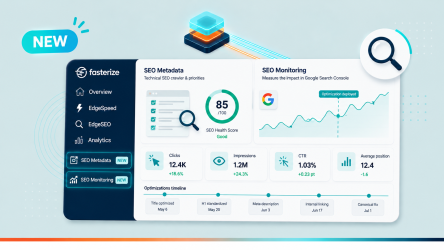
Approaches such as Fasterize’s EdgeSEO make it possible to bypass this bottleneck: without relying on a release cycle or involving your development teams, you can enrich and structure your product data directly across your entire catalogue, in a matter of days rather than months.
4 questions to ask now
- What is the real state of our product data quality? Missing attributes, inconsistencies between channels, synchronisation delays: run the audit.
- Do our SEO teams have access to and visibility over the PIM and feeds? If not, this is the first organisational issue to address.
- Do we have the ability to test data optimisations quickly without depending on a long IT cycle?
- Who is monitoring Google’s developments — AI Overviews, AI Mode, UCP — within your organisation? This topic cannot remain in a single silo.
EdgeSEO serving UCP feed quality
Before even submitting products to Google Merchant Center, you first need to ensure that the online catalogue reflects clean, consistent and structured data. This is precisely where EdgeSEO comes in.
By operating directly at CDN level, it becomes possible to intercept product pages on the fly to correct, enrich or filter data before it is crawled or exported.
Google offers several methods for feeding Merchant Center file, Google Sheets, API or automatic extraction via schema.org markup, but they all rely on the same requirement: properly formatted product data, because incorrect or missing data can generate errors in the account.
EdgeSEO therefore makes it possible to normalise critical attributes upstream : title, description, price, availability, GTIN, and more, directly in the headers or served HTML, without waiting for an application release. The result: a UCP feed generated from a more reliable online catalogue, fewer validation errors in Merchant Center, and a significantly shorter time-to-market for e-commerce teams.
Advice from our SEO expert: start improving the quality of your product data and its schema.org structured data markup now. If UCP operates exclusively through the configuration of a Google Merchant Center account, the reliability and completeness of your data will make the difference : price, stock, delivery times, attributes. And if your Merchant Center feed is generated directly from your site, the quality of your structured data becomes doubly strategic: it determines both your classic SEO visibility and your readability in new AI interfaces.
UCP is not revolutionising e-commerce today. Traditional journeys still dominate, and your site remains the main conversion point. But the trajectory is clear: AI interfaces will gradually position themselves between intent and purchase, and they will consume structured data, not web pages.
The merchants who win in this ecosystem will not necessarily be those with the best site. They will be those whose offer is the most readable, the most reliable and the best structured, regardless of the channel through which it is exposed.