








Spring 2025. An ecommerce director confided in me between two coffees: “I’ve just reviewed my paid campaigns… CPCs up 38% in a year. And yet my sales are flat. I’m starting to wonder whether I’ve become dependent.” A year on, things haven’t improved: acquisition costs remain stubbornly high while margins stay tight, and the marketing equation is as unstable as ever. Faced with advertising inflation, acquisition leaders everywhere are looking for breathing room. But where do you find it?
What if the answer was already there, underused, lying dormant?
SEO, a channel long dismissed as “slow or complicated”, is emerging as a strategic profitability lever, capable of reconciling controlled CAC with sustainable performance.
In this article, we make a pragmatic case for rethinking SEO investment, not as a cost centre… but as an asset that compounds ROI.
And because SEO is going through a profound transformation you simply cannot ignore, we’ll go further and talk about AI Search. With AI Overviews now firmly embedded in search results, this new frontier of organic visibility is rewriting the rules… and your budget trade-offs with them.
The ecommerce context: CAC running hot, ROI gasping for air
Ecommerce acquisition leaders see it at every budget review: paid campaign costs have settled at structurally high levels. According to the 2026 Google Ads Benchmarks report published by WordStream, based on more than 13,000 campaigns analysed, the average CPC stands at $5.42, more than double what it was a decade ago ($2.32 in 2016), with peaks of $9.87 in legal services and $8.33 in the home and garden sector. And while the metrics have paused after years of double-digit increases, that respite changes nothing fundamental: the average cost per lead sits at $66.69, and every pound of growth bought through paid is a pound you’ll have to buy again next month.
The conclusion is inescapable: at constant budget, your room for manoeuvre keeps shrinking. ROAS remains under pressure, campaign profitability stays fragile, and CAC never returns to its former levels. This structural imbalance weakens ecommerce models that depend on paid acquisition, DNVBs and emerging brands most of all. Advertising inflation is no longer a weak signal; it’s a permanent feature of the market.
Why SEO is strategic for ecommerce again
Against this backdrop of persistently high paid acquisition costs, SEO is re-emerging as a strategic alternative. Unlike ad campaigns, which require continuous spend, SEO works on an investment logic: every piece of content, every technical optimisation becomes a durable asset that keeps generating organic traffic at no marginal cost.
According to the SEO ROI Statistics 2025 report by First Page Sage, the average SEO ROI in ecommerce reaches 317% over 3 years, with a break-even point around month 16. In some sectors, such as property, that ROI can climb to 1,389%… $13 in revenue for every dollar invested. Far from being a supporting channel, SEO becomes a CAC shock absorber. It reduces dependence on ads, smooths acquisition costs over time, and strengthens overall profitability. For ecommerce businesses, it’s insurance against auction volatility… and a strategic opportunity that remains chronically underexploited.
SEO: a CAC/LTV lever that stays aligned over time
The main challenge in acquisition budget allocation today is breaking out of the “short-term profitable” reflex. Too often, channels are judged on their ability to deliver immediate results, forgetting that true profitability is measured across the entire customer lifecycle. And that’s precisely where SEO outperforms. Unlike paid, SEO acquisition costs don’t rise linearly with growth. A well-ranked piece of content can generate traffic for years without spending a penny more. According to SeoProfy, a well-optimised ecommerce site typically reaches positive ROI within 6 to 12 months, with an average organic conversion rate of 2.4%.
The compounding effect is essential here: a product ranking for several relevant queries can drive a steady stream of qualified traffic, mechanically lowering your average customer acquisition cost month after month. In short, SEO drives CAC down as it scales up… the exact opposite of paid.
Aligning CAC and LTV: the winning equation
For any acquisition leader running an ecommerce site, the challenge is aligning CAC with LTV (lifetime value). A sound benchmark targets an LTV/CAC ratio of at least 3:1. And SEO is the channel best placed to optimise that equation.
Take an example: an average customer spends £60 per order, 3 times a year, for 2 years. Their LTV is £360. If you acquired them through a paid campaign with a CAC of £120, your ratio is 3:1, but the slightest slippage erodes your margin. If that same customer came through SEO, at an estimated CAC of £30, the ratio jumps to 12:1, with a far more comfortable margin to reinvest.
Better still, SEO feeds LTV through indirect levers: educational content, cross-recommendations, a non-intrusive conversion funnel… It improves the experience, builds loyalty and stimulates repeat purchase. It becomes a post-acquisition activation lever, something paid can only do at the margins.
Budget trade-offs should no longer pit paid against SEO, but embed a logic of sustainable performance. SEO both lowers CAC and lifts LTV, a rare and strategic alignment for any ecommerce brand targeting long-term profitability.
Giving SEO its rightful place in budget decisions
Despite proven performance, SEO too often remains the poor relation in budget arbitration. Why? Because its return on investment is deferred. In an environment managed quarter by quarter, with expectations of immediate results, marketing leadership naturally favours levers with instant ROI. This bias is even more visible in ecommerce organisations where steering is heavily dependent on paid ROAS. And yet, taken over the long term, SEO delivers a higher net ROI with far lower volatility. According to a study by Terakeet, enterprise SEO generates on average 12.2 times more traffic than paid at equivalent budget.
In other words: SEO doesn’t lack profitability. It lacks financial storytelling.
Practical frameworks for defending your SEO budget
To bring SEO back into the overall strategy, you need simple, robust tools for the conversation with finance. Here are three approaches to deploy today:
1. Calculate projected ROI per keyword
Example: you target “designer office chair”, with 2,000 monthly searches. Aiming for position 3, you capture ~10% of clicks, 200 visits. At a 2% conversion rate and a £150 average order value, you generate £6,000/month. If the optimisation costs £6,000, you break even in one month.
2. Compare organic value against the equivalent paid spend
Tools such as Ahrefs or Semrush estimate what it would cost you to buy your SEO traffic through ads. This organic value is a powerful way to visualise the savings generated.
3. Value the indirect effects (support, brand awareness, retention)
A good FAQ reduces support costs. A well-ranked article attracts natural backlinks. A well-designed SEO funnel increases repeat purchase. All of this belongs in the extended return you include in your reporting.
These approaches let you speak the language of financial control, with concrete, comparable, tangible metrics. And often, that’s all that was missing to unlock a budget.
SEO isn’t just an acquisition channel… it’s a strategic asset. And like any asset, it deserves a valuation. By bringing legible metrics comparable with other channels, you give SEO the place it deserves in budget decisions: that of a profitability pillar.
AI Search: SEO reinvented for the era of generative answers
AI Search covers the set of practices designed to make your content visible, understandable and citable in AI-generated answers: Google’s AI Overviews and AI Mode, but also ChatGPT, Gemini and Perplexity. The goal? For your brand to be cited directly within the answers, before the first click even happens. Unlike classic SEO, which centres on rankings in results pages, AI Search focuses on how models extract information: clear named entities, logical structure, Q&A formats… all elements that increase the chances of your content being picked up. Read the full analysis of this shift on Search Engine Journal.
AI Overviews: already rewriting the rules of UK search
For UK ecommerce, this is no longer a forecast… it’s the daily reality of the results page. A growing share of queries now displays an AI-generated answer above the organic links, and the pattern is consistent: click-through rates fall on informational queries, but brands cited within the answers gain outsized visibility. One constant emerges across the markets that adopted AI Overviews first: the AIs preferentially cite content that is already structured and optimised… brands that move early build a lead that competitors then spend months trying to close.
Why AI Search is transforming ecommerce SEO
For ecommerce sites, this approach opens up a new seam of organic visibility. Products, guides, category pages, FAQs: all these formats can be structured to feed generative AI, capturing indirect traffic even without a click. According to an analysis by Search Engine Journal, the content most frequently picked up by AI engines features a clear logical structure, descriptive headings, concrete data and consistent semantics. The article specifically recommends Q&A formats, along with lists, tables and explicit summaries, to maximise extraction by language models.
And the stakes go beyond conversational assistants: AI agents, able to act on users’ behalf (comparing, selecting, buying), are already starting to browse ecommerce sites. A site that is readable by AIs today is a site ready for agentic commerce tomorrow.
Challenges & gains for acquisition leaders
Adopting AI Search involves concrete changes: structuring pages around frequently asked questions, adding extractable data, sharper semantic work… but the potential return is considerable.
- AI-first visibility: presence in AI Overviews and generative answers, without depending solely on traditional search results.
- Long-tail effect: content optimised for AI Search keeps being surfaced even without regular updates.
- SEO reinforcement: AI Search optimisation efforts also benefit your classic SEO rankings.
For ecommerce acquisition teams, that means a new surface of visibility with no cost per click, a way to reduce dependence on ads, and a fast-ROI lever when well executed.
AI Search isn’t a buzzword… it’s the natural extension of SEO into the AI ecosystem. Structuring your content so it can be understood, used and cited by generative models is becoming a necessity for anyone who wants to maintain (and grow) their organic visibility, and with AI Overviews now shaping the results page, it belongs on your roadmap, not on your watchlist.
So, where do you stand?
Our free simulator analyses your SEO & AI Search visibility against your competitors: Google rankings, presence in AI-generated answers, and estimated business impact based on your own data. Instant results, unlimited use.
In 2026, SEO is no longer optional. It’s the rational bet.
The numbers are there. Acquisition costs have doubled in ten years. Paid remains unpredictable. AI Overviews now sit at the top of the results page. And yet too many teams keep underinvesting in the one channel capable of generating ROI that grows the more you use it: SEO… and its natural extension, AI Search.
This isn’t a trend; it’s a structural shift. It isn’t an expense; it’s a shock absorber. It isn’t one lever among many: it’s the only lever you truly own.
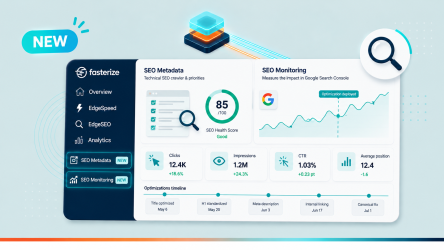
And this is where Fasterize changes the game. Our platform unifies web performance and AI Search visibility in one continuous loop: detect the friction points penalising your users, bots and AI agents, prioritise actions by business impact, deploy your optimisations directly from the edge, without depending on IT cycles, and monitor results continuously. Fasterize gives SEO and AI Search what they too often lack: velocity. Agility. Time-to-impact.
In 2026, doing SEO is no longer enough. You need to move fast, execute well, and scale… for users, for search engines, and for AIs.
And that is exactly what Fasterize makes possible.
SEO doesn’t promise you instant results. It guarantees you durable ones. And in 2026, that’s a luxury… but above all, a strategy.
A strategy that can (finally) be driven by ROI again.
Ready to put a number on your SEO & AI Search potential? Before reallocating a single pound of budget, measure your starting point: our simulator benchmarks your SEO visibility and your presence in AI-generated answers against your competitors, and translates the gaps into a quantified impact on your revenue.