















If you work in SEO today, you’ve certainly felt it. More pages, more formats, more channels, more expectations from the business… but no more time. And no bigger teams.
The real problem is no longer knowing what to do. Audits are full of recommendations and ideas are not lacking.
The real problem is execution. And doing it fast enough to stay competitive.
By 2026, Agentic SEO will no longer be an “interesting topic to explore”. It will become the main weapon of SEO teams that manage to keep up with the pace of e-commerce.
In this article, we’ll approach the topic from a practical perspective:
what it really is
why it changes the game for e-commerce
and how to start without building a complex technical stack
What is agentic SEO ?
Agentic SEO means stopping the reliance on already overloaded human teams for every SEO execution task, and instead relying on multiple AI agents that work together to handle SEO tasks, most often technical, repetitive, or time-consuming ones.
A quick clarification, as confusion is common:
- This is not SEO for AI (GEO).
- It is SEO with AI.
AI agents are not new. You may already be using them without calling them that.
The difference with agentic AI is that we are no longer talking about a single isolated tool, but rather a team of agents sharing the workload, much like a human team.
Concretely, an AI agent:
understands why it acts
retrieves the appropriate tools
executes a specific task
collaborates with other agents
iterates until it produces a usable result
An orchestrator (such as n8n, Make, Zapier or integrated platforms like Draft & Goal) connects everything together, triggers actions and manages dependencies.
Once deployed, the workflow can operate continuously, provided that what it produces can actually be published online. And that is often where things become complicated.
How does an agentic workflow work?
When implementing Agentic SEO, you don’t start by choosing a tool. You start with a real problem, one you are probably already facing.
For example: “We can’t keep our category pages updated anymore.” “Our product pages don’t keep up with trends.” “We know what to optimise, but we never manage to deploy it.”
The next step is to break down the actual process as it exists today. Each step becomes an AI agent with a clear role. You then select the most appropriate LLM for each task rather than using a single model for everything.
Then comes collaboration between agents.
There are two main approaches: build your own workflows (Zapier, Make, n8n) or use an integrated solution such as Draft & Goal
In all cases, one rule never changes: A human always remains in the loop. SEO remains a discipline based on judgement, prioritisation and context.
But there is one critical point: a workflow that analyses and produces outputs without being deployed is useless. And this is exactly where many teams get stuck.
Why agentic SEO is transforming e-commerce
If you work in e-commerce, you’ve seen the landscape evolve rapidly, commercial peaks follow one another with little downtime, products appear and disappear faster than ever, product pages must become richer and more frequently updated, trends can explode and disappear within days and AI bots are becoming new “readers” of your website.
For SEO teams and CDOs, this creates constant pressure: do more, faster, with the same team. SEO agility has become a direct business performance factor, or conversely, a factor of competitive decline.
With Agentic SEO, responsiveness is no longer reserved for highly technical or heavily staffed teams. It becomes an accessible lever, provided that the right workflows are in place.
What soes an agentic SEO workflow look like?
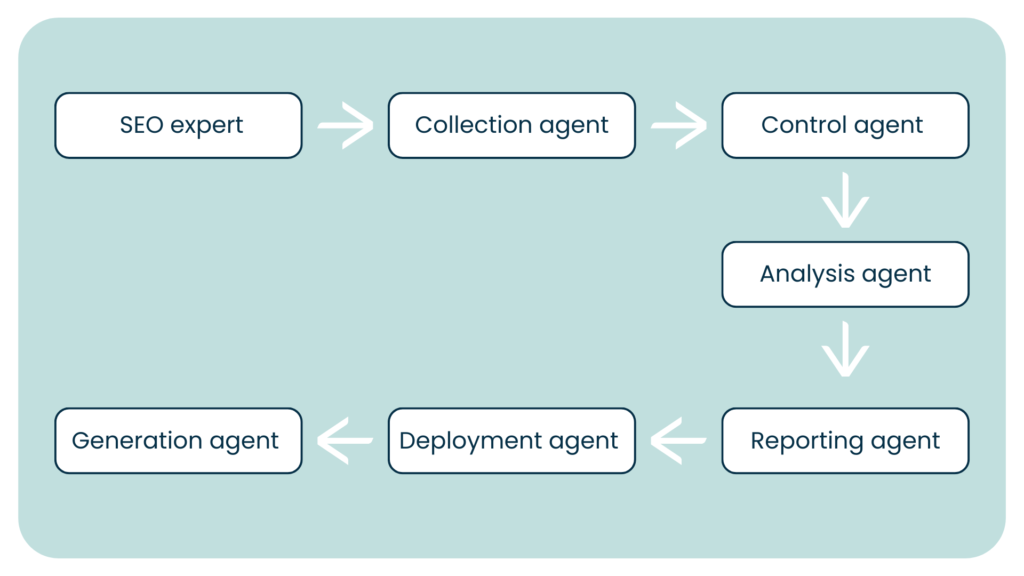
You can think of it as a continuous SEO production chain, rather than a series of isolated tasks.
The SEO expert sets the direction, defines the rules and establishes the level of autonomy.
Agents then collect data, analyse it, prioritise actions, generate content or recommendations, verify results, deploy changes… SEO no longer operates through individual actions but through continuous flows.
The result: fewer manual tasks, fewer oversights, greater consistency and above all, the ability to handle scale.
Concrete agentic SEO use cases for e-commerce
Agentic SEO is no longer theoretical.
Here are examples already implemented by some e-commerce companies:
Real-time monitoring of social trends to create pages and capture emerging demand
Automated creation of Searchdexing-type pages to capture new opportunities
Internal linking optimisation to promote pages based on weather or demand trends
Intelligent management of high-potential categories from both a business and SEO perspective
Enriching content to be LLM-friendly (summaries, FAQs, structured answers)
ROI-first automated reporting workflows
Automated management of seasonal content and recurring events
And this is only the beginning. Once you start thinking in workflows, new ideas appear very quickly.
What really makes the difference
With experience, four principles always emerge.
- If the process is unclear, AI will not fix it.
You must first clarify how your current processes actually work. - One agent = one clear role.
This guarantees reliability and performance. - Keep the human in the loop.
Humans remain essential to validate, supervise and correct. - Without fast deployment, workflows quickly become obsolete.
Velocity is critical.
Why agentic SEO fails without instant deployment
This is often where things break down. AI agents operate in minutes. IT cycles operate in days or weeks.
The result: SEO tickets accumulate, priorities shift, optimisations arrive too late. You lose real-time responsiveness. And in e-commerce, losing real-time responsiveness means losing revenue.
EdgeSEO: taking action today
This is exactly where EdgeSEO comes in. It allows you to deploy SEO optimisations instantly, without modifying source code and without depending on IT roadmaps.
Concretely, this means: testing faster, correcting more frequently, iterating continuously and finally aligning SEO execution with business objectives. SEO is no longer stuck at the recommendation stage. It becomes an execution engine.
By 2026, the teams combining Agentic SEO and EdgeSEO will not simply be “doing SEO”. They will be driving growth.
If you want to go further, our dedicated EdgeSEO page explains how.