









article img {
margin:15px auto !important;
}
If your site is mobile-friendly, you win points with Google!
A few days ago, we read an interesting article published by Olivier Andrieu on the abondance.com website, which explains in a little more detail what it’s all about.
What you need to know about Google’s update
- The new algorithm will only affect Google’s mobile results. Your search engine ranking on desktop should therefore remain unaffected by this update.
- The launch will take place directly worldwide (and not in the USA first). “The “switch” will therefore be unique and for all countries.”
-
- To benefit from this advantage, your site doesn’t have to be in responsive design. You can have a mobile site on a different URL or user-agent detection. All 3 methods are supported by Google.
What’s more, this update will be applied on a “page-by-page” basis. So if you only have a few mobile-optimized pages: these will be boosted by Google, even if your entire site isn’t “mobile friendly”.
- To benefit from this advantage, your site doesn’t have to be in responsive design. You can have a mobile site on a different URL or user-agent detection. All 3 methods are supported by Google.
- But (and this is where we wanted to react): “The April 21 algorithm doesn’t take into account page loading speed (which is important on mobile).”
This last point echoes a few articles we’ve published in recent days on the “Red Slow Label” and the importance of site performance on SEO.
So what about speed on mobile?
While Google’s algorithm doesn’t currently take into account the speed of mobile sites, we shouldn’t forget that loading speed is a criterion taken into account by Google.
On the other hand :
-
- loading speed is the top quality sought by mobile users (41%) [1], and 74% of them would abandon their mobile browsing on a site that took more than 5 seconds to display [2].
-
- optimizing a website, and with it its mobile site, improves the conversion rate on mobile, and to a far greater extent than on desktop.
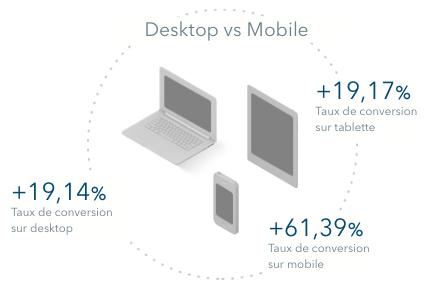
source: figures from a case study
- optimizing a website, and with it its mobile site, improves the conversion rate on mobile, and to a far greater extent than on desktop.
-
- server response time has an impact on SEO [3]:
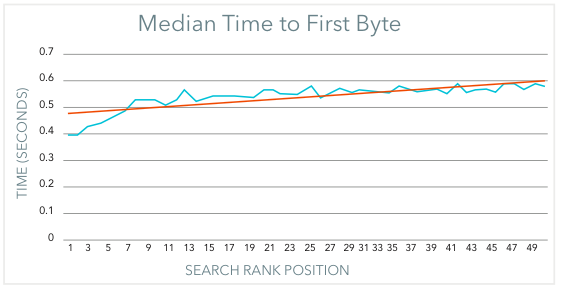
- server response time has an impact on SEO [3]:
- according to a case study conducted by www.leparisien.fr, site acceleration doubled traffic and average time spent on the site, and reduced the bounce rate for SEO users. [4]
So stay vigilant and keep up the good performance!
Read also:
- How important is site performance for SEO?
- 6 things you need to know about HTTPS migration
- [Infographic] Sales 2015: E-commerce site performance in 5 metrics
- Speed Index: a key metric for user experience
Sources
[1] Based on a study conducted by Netbiscuits in summer 2013.
[2] Based on a study conducted by Mobilosoft in May 2012.
[3] According to the article “Improving Search Rank by Optimizing Your Time to First Byte” by Moz.
[4] According to the Use Case of Le Parisien presented at SEO Camp’US 2015 by Guillaume Giraudet and Sacha Morard.